
And Then We Added the Monkey Drum
This is a post about the recently released and no-doubt controversial 'song' TRAVIS by 'band' Wolfugue.
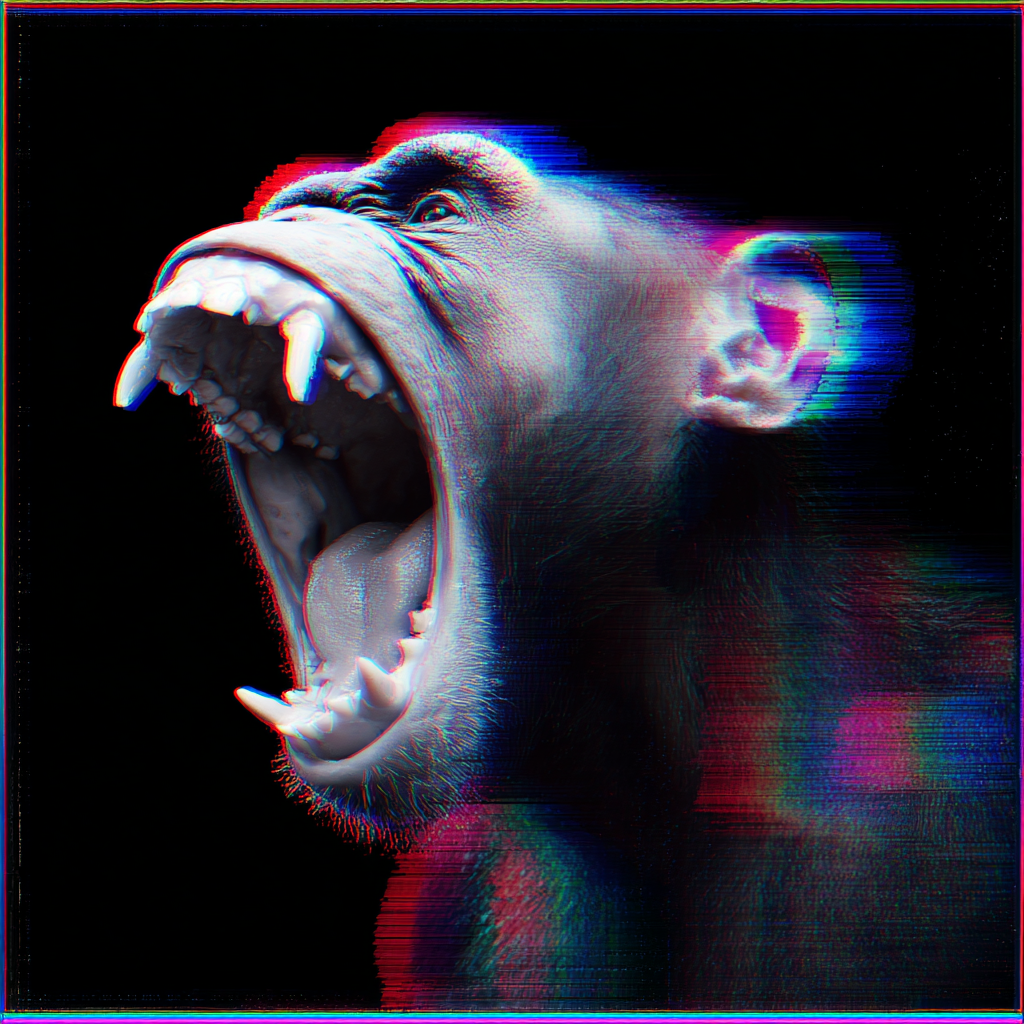
On 911 Calls, Primate Panic, and Why Every Era Gets the Art It Deserves
There are certain audio recordings that refuse to stay in their original context. They slip the leash of journalism and become something else: folklore, meme, cautionary tale, cursed artefact. The 2009 911 call made during the Travis the chimpanzee incident is one of them.
The Charla Nash incident itself has become so heavily mediated that it’s easy to forget the basic facts beneath the noise. On 16 February 2009, Nash visited the Stamford, Connecticut home of her friend Sandra Herold to help coax Travis — an obese 14-year-old male chimpanzee weighing close to 200 pounds — back into the house. Travis had been raised in near-total domestic captivity, dressed in clothes, fed human food, medicated with Xanax, and treated less as an animal than as a family member. When Nash attempted to interact with him, Travis attacked without warning, inflicting catastrophic injuries to her face and hands. By the time police arrived, Nash had suffered injuries so severe that they were initially believed to be unsurvivable. Travis, after being stabbed by Herold with a kitchen knife and struck with a shovel, advanced toward a responding officer and was shot. He later died from his wounds.
The aftermath that followed was both medical, legal aftermath, and cultural. Nash survived, undergoing years of reconstructive surgery and becoming an unwilling emblem of the dangers of exotic pet ownership. She 'showed her face' on Oprah (watch it here). People wanted to see. 3.1 million views on YouTube.
Herold (who died shortly after), became a lightning rod for public scrutiny — portrayed alternately as a grieving caretaker, a delusional enabler, or a symbol of a broader American fantasy about mastery over nature. Despite the severity of the incident, reports later emerged that Herold attempted to acquire another chimpanzee, reinforcing the sense that the lesson had not landed. This pattern — affection curdling into entitlement, care mutating into control — is precisely why the Travis case continues to resurface whenever the cultural conversation turns to captive primates and human projection.
That legacy is explicitly revisited in Chimp Crazy, the recent documentary series by Eric Goode, creator of Tiger King. While the series focuses on contemporary cases, Sandra Herold and the Travis incident function as a grim point of reference throughout — a kind of origin myth for the genre. Archival footage, media excerpts, and retrospective commentary position Herold as an early example of a recurring archetype: the owner who insists on intimacy without accepting limitation. In this framing, the Travis case is no longer an isolated tragedy but a template, one that Chimp Crazy suggests we keep reproducing under different names, different animals, and different streaming contracts.
The call itself was also made public, and has garnered over 2.5 million views.
Over the years, fragments of that call have circulated with a strange persistence. There is a longstanding public fascination with this morbid piece of realia. Pleas. Imperatives. The sudden collapse of domestic fantasy into animal reality. It’s an audio document that sits uncomfortably between tragedy and the grotesque, which may explain why artists keep returning to it like moths to a distress beacon.
One of the earliest and most notorious musical appropriations came from Suicide Silence, who used the call in their track And Then She Bled. It was controversial on release and remains controversial now. For some listeners it was a critique of sensationalism; for others, just sensationalism with better mastering. Either way, it cemented the 911 call’s transition from news item to cultural raw material.
But for all its extremity, And Then She Bled doesn’t really sound like a chimpanzee. In fact there is no monkey-sound at all! It sounds like metal doing what metal does—amplifying human panic, aggression, and catharsis. The animal at the centre of the event becomes abstracted, flattened into noise. The monkey disappears.
Which raises a question that only the internet could make inevitable:
What if the problem wasn’t that the call was used—but that it wasn’t used accurately enough?
Enter the cuíca.
For the uninitiated, the cuíca is a Brazilian friction drum capable of producing an uncanny range of squeals, groans, and yes—monkey-like vocalisations. It’s a carnivalesque instrument, often comic, sometimes unsettling, and deeply bodily in its sound. When deployed in a context like this, it doesn’t heighten the horror so much as expose the absurdity beneath it.
Adding a cuíca to a track built around the Travis 911 call is rather a specific flavour of satire. It's the dark liquorice of satire, the one that's good for you but stains your lips. It forces the listener to confront how strange the entire situation already was: a 200-pound chimp raised like a child, medicated, anthropomorphised, paraded through media appearances, and ultimately expected to behave like a plush toy with opposable thumbs.
This is where Jordan Peele’s Nope (2022) enters the chat. Peele’s “Gordy” subplot—an eerily restrained fictional echo of the Travis incident—understood something crucial: the real horror wasn’t the animal. It was the human insistence on spectacle, control, and narrative mastery. It was the moment when the dance shoes come off and the cloven hooves start gauging the floor.
The 911 call has endured because it’s shocking and because it captures a uniquely modern collision: celebrity culture, exotic pet delusion, pharmaceuticals, and the unshakeable belief that love can overwrite biology. Those who listen to it are always going to be morbidly curious. We replay it the way previous generations replayed ghost stories or public executions: half-warning, half-entertainment.
So when a contemporary artist decides that the call needs more monkey, it’s escalation commentary. The cuíca doesn’t mock the victim or glorify the violence. It mocks us: our fixation, our inability to let the artefact rest, our endless remixing of trauma into content.
If And Then She Bled was a document of its time—raw, confrontational, eager to shock—then the cuíca version belongs to now. An era that knows it’s complicit. An era that can’t look away. An era that understands, dimly, that the most unsettling sound in the whole story is the fact that it really needed to sound more monkey-like.

Comments ()