
Lasanum Skibidiense - An Ancient Roman Satire | The Scriptorium Brainrot
Discover how an imperial latrine puppet named Lasanum Skibidiense terrified Emperor Domitian in 95 CE. Read the definitive, translated text of Pliny’s warning.
The Pliny Prologue
From Gaius Plinius Caecilius Secundus to his friend Cornelius Tacitus, greeting.
I write to you from my villa at Laurentum, where the air is clear, yet my mind remains clouded by the reports arriving from the city. A strange and base distemper has seized the plebeians of the Subura, one which I fear portends a rot deeper than any grain shortage or fiscal deficit.
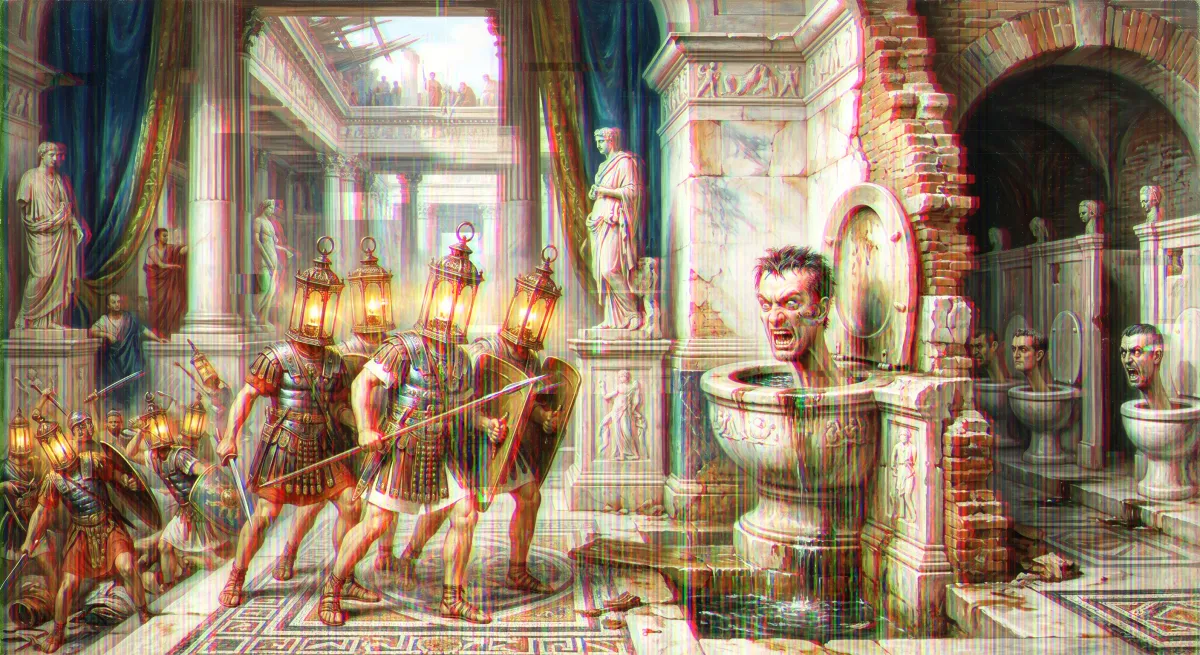
It is not a conspiracy of steel, my dear Tacitus, but of clay and wood. There is a freedman, a maker of low theatrical trifles, who has abandoned the noble mimes of Livius Andronicus for a spectacle so utterly devoid of logos that it seems birthed from the vapors of the Cloaca Maxima itself. He has fashioned a mechanism wherein a grotesque terracotta head emerges from a mock privy, chanting a rhythmic, uncial gibberish that mimics the crude battle-cries of our northern borders.
The youth are enchanted. Even the slaves in my own household have been observed nodding their heads in a repetitive, spasmodic cadence, muttering these same meaningless Thracian syllables under their breath while pouring the Falernian. The patrician houses treat it as a novelty; the Emperor’s inner circle sees in it a mirror of some hidden factional treason. For my part, I see only the terrifying velocity of absolute nonsense. When the mob no longer requires even a narrative to be amused, how can the state expect them to respect the laws? Come to me before the Saturnalia; we shall drink wine untouched by this madness and speak of better centuries. Farewell.
The Puppeteer
The Subura smelled of parboiled turnip, unwashed wool soaked in stale urine for the fullers, and the damp, yellow tallow of low-grade oil lamps. Here, three storeys up in an insula that groaned whenever the Tiber swelled, Lucius the puppeteer sat among the debris of a dying trade.
His fingers were stained with the grey silt of Etruscan clay. Around him hung the flaccid, wooden corpses of the old world: a cracked Agamemnon with one eye bored out by weevils, a Venus whose gesso thighs had flaked away to reveal the cheap pine beneath, and several satyrs with exaggerated phalluses that had ceased to elicit even a chuckle from the drunken dockworkers of the Emporium. The traditional gods were a bad investment. The public had grown numb to Olympus. They wanted a spectacle that matched the frantic, crowded violence of their own brief lives.
The apparatus that would ruin him was born of necessity and a broken water basin. Lucius had salvaged a discarded lasanum—a portable earthenware toilet box—from the courtyard of a wealthy merchant’s townhouse. It was a utilitarian object, stained with the green verdigris of copper plumbing and the faint, persistent tang of aristocratic piss and bile. To its rear, he rigged a crude hemp pulley system and a counterweight made from a lead fishing sinker.
The head itself was a masterpiece of the vulgar. Lucius had sculpted it from coarse, unrefined clay, baking it in a communal bread oven until it was brittle and red as a sunburnt Thracian. It had no neck; it was merely a bulbous cranium with a jaw hinged on a leather thong. When Lucius yanked the hidden cord, the head jerked upward from the aperture of the toilet with an aggressive, pneumatic violence, its mouth snapping shut with a sharp clack.
"Ski-bidi," Lucius muttered into the dim room, his throat dry from charcoal smoke. He pulled the cord again. The head bobbed. Clack. "Ski-bidi... bidi... bai."
The phrase had no root in Greek or Latin. It was a phonetic anomaly he had overheard from a foreign sailor dying of a fever in a tavern near the docks—a rhythmic, staccato barking that seemed to bypassed the intellect entirely and strike directly at the base of the skull. To provide the necessary dramatic friction, Lucius constructed the antagonist from a broken bronze lantern used by the night-watch. He mounted the cylindrical lamp atop a framework of split wicker covered in coarse, unbleached linen—the rough, grey toga pulla of the mourning classes. It had no face, only the dark, glass lens of the oil burner, staring with the blind, unblinking surveillance of the state.
When the two figures were placed on the small, grease-slicked wooden stage at the corner of the Argiletum, the effect on the afternoon crowd was immediate and terrifying. A crowd of fishmongers, water-carriers, and Syrian fruit-sellers stopped dead in the mud. They did not laugh at first. They simply watched as the giant lantern-man advanced with stiff, militaristic lurches, only for the red clay head to pop from its porcelain tomb, its jaw clattering in that ceaseless, rhythmic "skibidi" war-cry. By the third repetition, a group of young weavers from the Aventine began to mimic the bobbing motion of the terracotta skull. Their heads moved in unison, their eyes glazing over with a strange, ecstatic vacuum. By nightfall, the coin-purse at Lucius’s belt was heavy with bronze quadrantes, and the phrase had already breached the stone walls of the Forum.
The Contagion
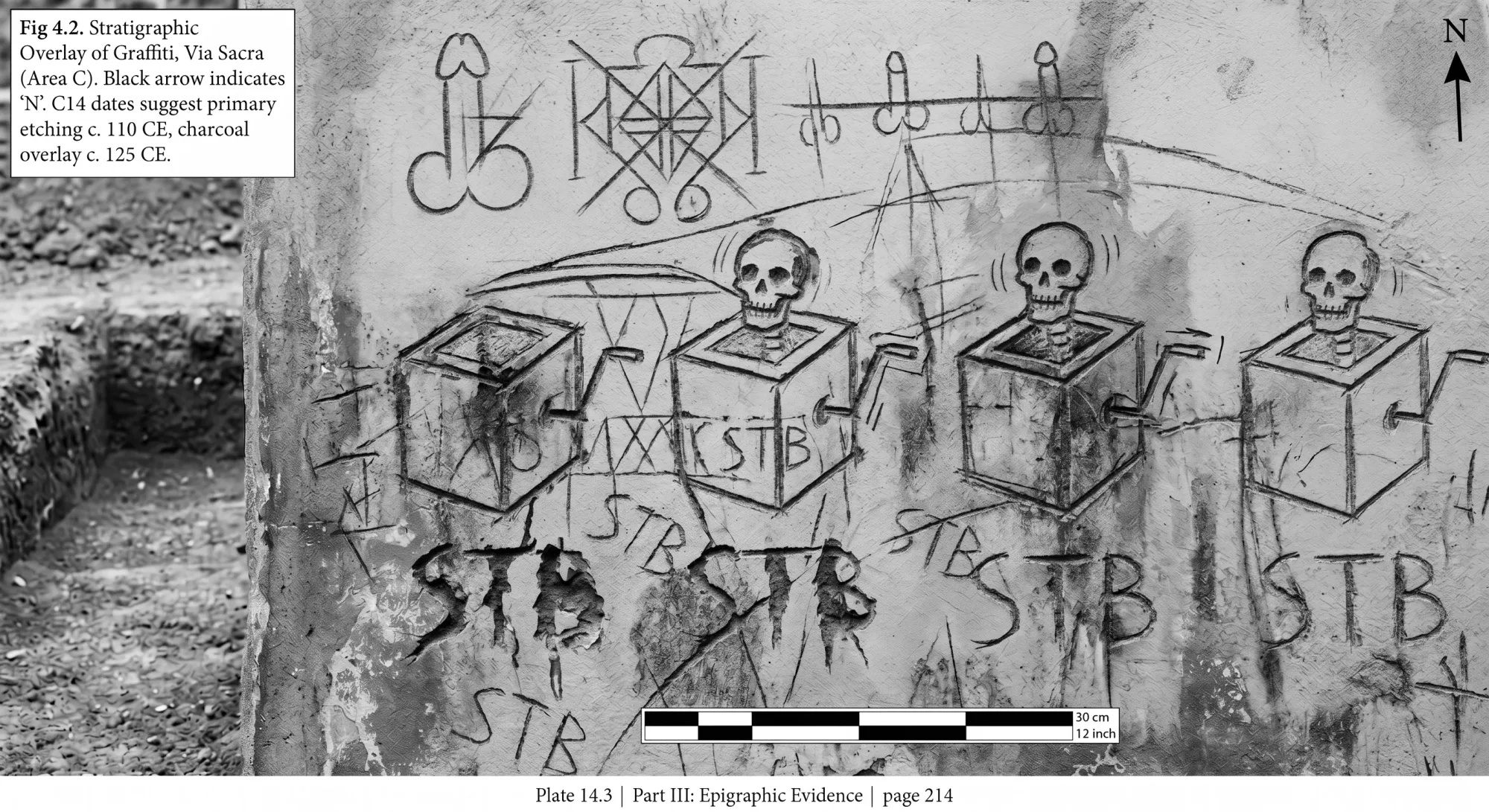
The meme moved through the city like the enteric fevers that rose from the Marshes in September, indifferent to brick, stone, or social rank. Because Rome possessed no printing presses, the algorithm was purely flesh and stone: the narrow, vaulted alleys of the Velabrum served as conduits; the communal latrinae, where sixty men sat shitting hip-to-hip over running water, became the echo chambers. Within nine days, the graffiti began to mutate. The traditional, elegant phalluses and electoral endorsements scratched into the soft stucco walls of the Via Sacra were scrubbed over with crude charcoal renderings of the porcelain cube and the bobbing, lever-activated skull. Underneath these images, schoolboys scratched the Roman cursive—STB—a linguistic shorthand that bypassed the complex rhetoric of the grammarians entirely. The patrician response was a mixture of perfumed panic and absolute, academic over-thinking. In the gardens of Sallust, where the senators gathered in tunics of Tyrian purple—so heavily drenched in cinnamon oil that the wasps hovered around them in dense, droning clouds—the phenomenon was debated as if it were a lost dialogue of Plato.
"It is an obvious allegory for the Parthian campaign," declared Lucius Calpurnius, lifting a silver dish of dormice glazed with poppy seeds and wild honey. He adjusted his toga vitrea, the silk so thin it was virtually translucent, revealing even more of his gout-swollen joints. "The vessel represents the containment of the eastern barbarians; the lantern is the watchful eye of the consular legions. The music is Thracian. It is a triumphalist piece disguised as a low comedy to appease the vulgus."
"Nonsense," spat Clodius, a young tribune whose face was painted with white ceruse to hide the scars of a youthful debauch. He sniffed a sprig of mint to drown out the stench of the common street that drifted over the high stone walls. "The toilet is the Senate. The head is the populist faction, rising repeatedly from the ordure of democratic assembly to defy the traditional magistracies. It is a call for a new dictatorship."
They could not grasp the horror of the void of meaning. They could not understand that the plebeians were not cheering for a political faction, but for the sheer, rhythmic annihilation of semiotic intention. It was just fun. Just brain rot. It was entertaining. It was funny precisely because it meant nothing. The absurdity made it universally appreciable. Meanwhile, Lucius the puppeteer no longer slept. He had been moved from his three-storey insula to a damp cellar behind the Theatre of Pompey, funded by a syndicate of Greek freedmen who smelled profit in the mob’s fixation. His fingers were permanently split from the friction of the hemp cords; his ears rang with the eternal, dual-tone cadence of his own creation. He was no longer a man; he was the twitching appendix of a mechanical monster. Every hour, a new delegation of clients arrived at his door: bath-house managers offering gold pieces for a three-minute performance to draw customers to their tepidariums; campaign managers for municipal elections begging him to have the terracotta head clack its jaws in rhythm with a candidate’s name; and finally, a silent, heavily guarded litter from the Palatine Hill.
The curtain of the litter parted to reveal the Editor of the Imperial Games—a man whose skin was the colour of old parchment, wearing a heavy gold signet ring depicting the flayed skin of Marsyas.
"The Emperor has heard the whistling of the street-boys," the Editor said, his voice flat, smelling faintly of the myrrh-scented lozenges he chewed to preserve his larynx. "He is amused by the novelty. He is displeased by the lack of order. You will bring your... apparatus... to the Flavian Amphitheatre for the August Games. You will scale it to the size of an elephant. If the crowd roars as they roar in the slums, you shall have ten thousand sesterces and your freedom from the guild tax."
The Editor leaned closer, his eyes cold as glass beads. "And if they do not roar, the beasts have not been fed since the Nones of July."
The Flavian Amphitheatre
The heat within the Flavian Amphitheatre was an active, predatory thing. It compressed fifty thousand bodies into a single, sweating organism that smelled of rancid lard, stale garum—the fermented fish gut sauce that the plebeians poured over their cold spelt porridge—and the sharp, chemical tang of cheap sulfur wine. To keep the patricians in the lower tiers from fainting, slaves with copper cylinders patrolled the marble barriers, spraying a fine mist of water infused with saffron and rose oil into the air. It did little to mitigate the stench of the arena floor below, where three hundred gladiator corpses had been dragged out through the Gate of Libitina only an hour prior, leaving the sand dark, wet, and clotted like a butcher’s bench. Above, the velarium—the massive canvas awning managed by a detachment of sailors from the Misenum fleet—creaked against its masts, filtering the brutal August sun into a sickening, jaundiced yellow light.
Lucius stood in the darkness of the hypogeum, the vast labyrinth of brick tunnels and timber lifts beneath the arena floor. Above his head, the timber planks of the stage rattled under the weight of the shouting mob. He was dressed in a rough, unbleached tunic that felt like sandpaper against his skin, his hands slick with oil from the massive iron gears of his scaled-up contraption. The imperial box was a mountain of purple silk and polished ivory. Emperor Domitian sat upon his curule chair, motionless as a gilded corpse. His face was naturally flushed—a deep, permanent red that his sycophants swore was the blush of modesty, but which the history books would note as the congestion of a tireless paranoia. He wore a heavy oak-leaf crown wrought from beaten gold, and his fingers twitched against the armrest of his chair in time with a rhythm only he could hear. Surrounding him were his frumentarii—the grain-inspectors turned secret police—who stood with their short iron swords hidden beneath their heavy toga folds, their eyes scanning the crowd for any hand gesture that smelled of sedition.
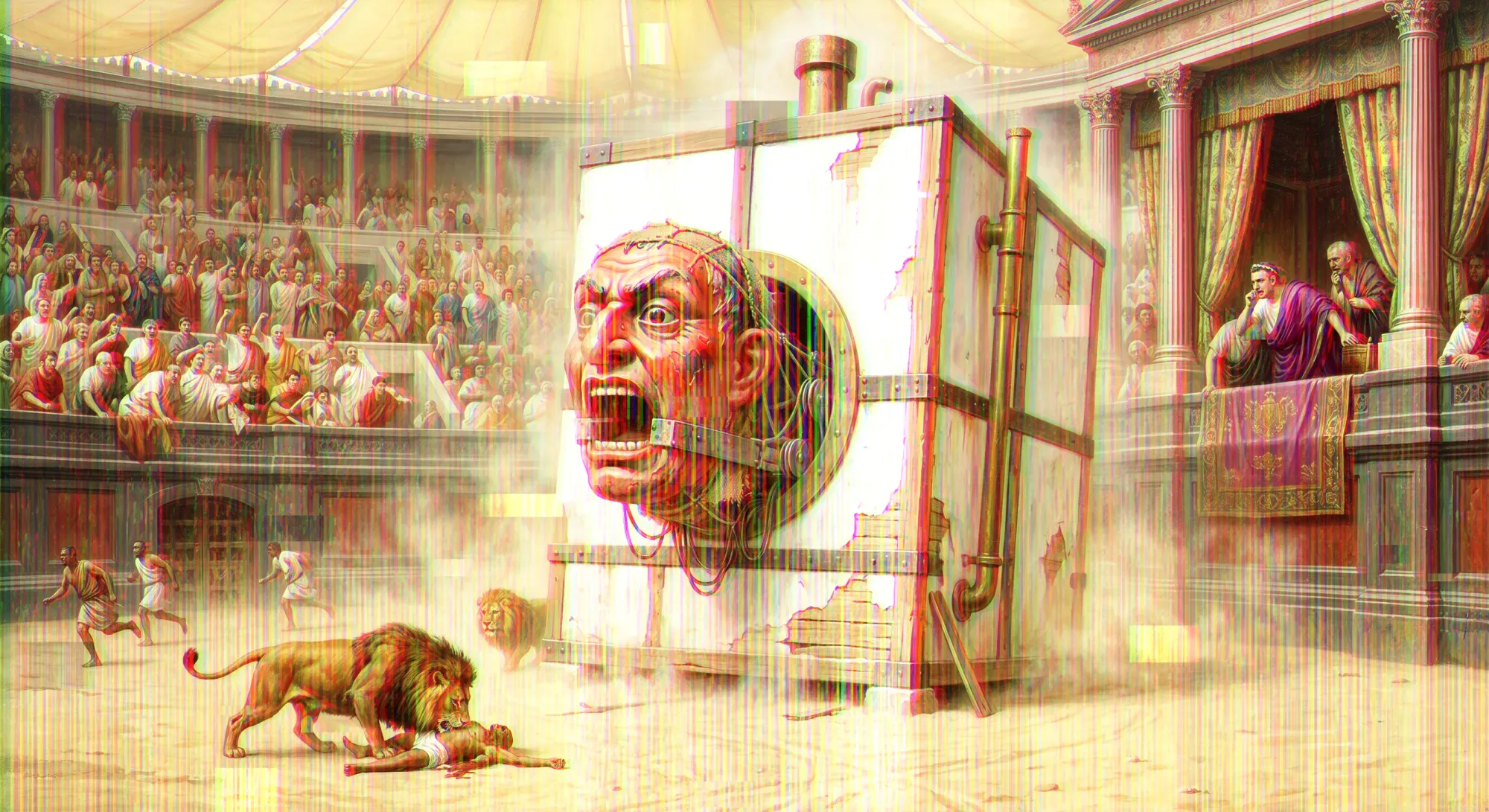
"Let the novelty proceed," Domitian murmured. He did not drop his linen napkin; he merely flicked two fingers. A horn blew—a deep, flat Thracian buccina blast that vibrated through the limestone foundations. From the center of the arena, the great timber trapdoors groaned open. A system of twenty capstans, turned by eighty sweating slaves in the dark below, began to heave. Slowly, the colossus rose into the yellow light. It was a monstrosity of timber, wicker, and painted canvas, standing thirty feet high. Lucius had spent three weeks in the naval shipyards at Ostia overseeing its construction. The lasanum was no longer a terracotta box; it was a massive tower of pine planks covered in white plaster to mimic Carrara marble, fitted with brass pipes that gurgled with stagnant water. Inside the hollow core of the structure, Lucius sat upon a iron crossbeam, his muscles straining against a double-handed winch. Beside him, four slaves held the heavy hemp cables that controlled the counterweights.
"Now," Lucius hissed through his teeth.
He released the iron dog. The winch spun with a high-pitched, metallic scream. Through the circular opening of the massive wooden privy, the head ascended. It was a terrifying engine of gesso-stiffened linen and cured ox-hide, painted the violent, unnatural red of a flayed man. The jaw, weighted with lead bars, dropped open with a thunderous BOOM that echoed off the stone tiers. From the bellies of the slaves hidden within the white tower, a sixty-voiced chorus bellowed the phonetic liturgy of the Subura:
Lasanum Skibidiense (Ah!)
Lasanum Skibidiense (Sic-Sic-Sic)
Lasanum Skibidiense
Crepitat, crepitat, crepitat, sic, sic!
Skibidi crepitat, crepitat, crepitat, skibidi!
Sonat, sonat, sonat, sic, sic!
Skibidi sonat, sonat, sonat, skibidi-babae-babae!
The crowd did not cheer. For three seconds, fifty thousand Romans simply stared, agog. The sheer, colossal idiocy of the sight—a thirty-foot head emerging from an imperial latrine to bark nonsense at the heavens—seemed to crack the very foundations of their classical education. The senators froze, their silver spoons suspended above their bowls of iced figs. The soldiers of the Praetorian Guard lowered their spears by a fraction of an inch, their disciplined minds utterly unequipped to process a theological threat shaped like a commode.
Then, the plebeians in the upper tiers—the slaves, the foreigners, the prostitutes in the summa cavea—began to scream. It was the feral, hysterical roar of a mob that had found its god. A thousand voices joined the chant. Then ten thousand. The stone benches vibrated. Ski-bidi. Bidi. Babae. The rhythm was infectious, a mental parasite that passed from the unwashed dockworkers down into the middle tiers, where the knights and equestrians began, despite themselves, to nod their perfumed heads in that same rhythmic, vacant cadence. The sheer joy of something that was mindlessly funny simply spread throughout the amphitheatre and electrified the audience.
Lucius, suspended in the dark core of the machine, felt the vibration through his sandals. He smiled too, his face covered in grease and sweat. He had done it. He had conquered Rome with stone-age brainrot. He looked through a small peephole in the canvas toward the imperial box to witness his triumph. He expected to see an amused emperor. He saw Domitian leaning forward, his crimson face pale beneath his gold crown, his lips moving rapidly as he whispered into the ear of his prefect. The Emperor's eyes were wide, fixed on the bobbing gesso and woven osier head with a look of absolute, cold terror. Despite the crowd and the feeling of success, a white wall of dread flared up inside him, causing his fatigue and muscular aches to engulf him.
The Hermeneutic Trap
To the paranoid intellect, there is no such thing as nonsense. In the small, fevered theatre of Domitian’s mind, the universe was an intricate tapestry of daggers, all aimed at his throat. He simply could not comprehend the very idea of a meaningless vulgar joke. Before him, he saw a terrifyingly sophisticated piece of semiotic warfare. He looked at the massive, grotesque, theatrical skull clacking its jaws and saw the ghost of his brother Titus. He looked at the white-plaster privy and saw a mockery of the Imperial Treasury, hollowed out and filled with filth.
"The lantern," Domitian whispered, his fingers tearing at the purple silk of his tunic until the gold threads snapped. "Where is the lantern-man?"
"He... he has not yet ascended from the pit, Caesar," stammered the Editor, whose forehead was now dripping onto his ivory tablet.
"The lantern is the Frumentarii," the Emperor hissed, his teeth clicking together like those of a rabid hound, almost mimicking the clacking head that offended him so. "The secret watch. He is showing the mob that the state is blind, that the watch can be defied by a head rising from the offal. The music is Thracian—the very province where the legions mutinied last winter. It is a signal. The rhythm... look at them! The knights are nodding. The legions are nodding. He has hypnotized my court with the cadence of an uprising."
He turned to the Prefect of the Praetorians, who stood like an iron statue behind the throne.
"Kill the music," Caesar commanded. "Drop the grates. Let the arena be purged before the infection reaches the streets."
Inside the mechanical colossus, Lucius was celebrating his third repetition. The winch was hot to the touch, smelling of scorched lard. The slaves were screaming the chant with the evangelical fervor of wine-drunk bacchants: "SKI-BIDI! BIDI! BAI!"
Then came the sound that every man in Rome feared more than thunder. It was the screech of ungreased iron—the massive, three-ton portcullises that sealed the underground dens of the bestiarii. They were dropping twenty minutes before the intermission. Through his peephole, Lucius saw the sand shift. From the darkness of the southern tunnels emerged sixty North African lions, their humped spines yellow against the blood-soaked grit. They were not the elderly, sluggish beasts used for the morning executions; these were the prime hunters from the Numidian desert, starved for three days and blinded by the sudden, yellow glare of the Flavian sun. The chant in the tiers faltered, then died into a suffocating, collective gasp.
The lions did not attack a man; there were no men on the sand. They saw only the thirty-foot white tower, shaking and gurgling with brass plumbing, and they heard the deep, rhythmic, sixty-voiced booming that issued from its belly. To a wild beast, the sound was the territorial roar of a rival predator—a monstrous, square-bodied elephant that had challenged their pride. And it smelled of their usual prey: sweating, fearful idiota.
"Maccus!" Lucius screamed to the slaves below, his voice cracking. "Reverse the gears! Pull the counterweight! Drop the head!"
But the slaves had already fled into the tunnels of the hypogeum, dropping their lines. Left without a counterweight, the massive head remained stuck at its highest extension, its lead-weighted jaw hanging open in a permanent, static scream of terror. The first lion struck the plaster-and-wicker base with the force of a catapult, its claws tearing through the canvas to reveal the pine framework beneath. Another followed, then five, then twenty. The colossus began to sway, its hemp cables snapping with a sound like a broken ballista.
Inside the dark, tilting chamber, Lucius clung to the iron crossbeam. He looked through the tear in the canvas and saw the imperial box. Domitian was standing now, his gold crown askew, his face restored to its natural, triumphant crimson. The Emperor was clapping—not with amusement, but with the dry, rhythmic precision of a judge who had successfully parsed a difficult text. The machine went down with a splintering roar that shook the lower marble tiers. The white plaster cracked, pouring out a cloud of grey lime dust and splintered willow reeds that choked the lions and filled the air with the smell of dry tombs.
Lucius lay among the shattered pine planks, his ribs crushed, his legs pinned beneath the heavy lead jaw of his own creation. The dust settled, yellow and thick in the sun. Through the ruins of the wickerwork, he saw a great Numidian male approaching, its nose twitching as it sniffed the grease on his tunic. The amphitheater was completely silent. Fifty thousand Romans sat in the jaundiced light, waiting for the moral of the play.
Lucius looked up into the yellow eyes of the beast. His chest heaved, a bubble of dark blood forming on his cracked lips. He wondered for a split second if he should offer a prayer to Jupiter. With his final, dying breath, he looked at the crowd, opened his mouth.
"Nonne delectamini?" he gasped into the sand, his voice a dry, rattling hiss.
"Cacator!" he screamed as the lion closed its jaws around his neck. It was quick but savage, and the public went home to change their tunics for dinner, entirely convinced they had witnessed the execution of a philosopher.
Help fund our research into utter bullshit and making stuff up that's demonstrably not true. Become a supporter. We cannot afford to eat dormice.
https://sarcgasm.com/#/portal/support
Comments ()