
Louvre Confirms Mona Lisa Replaced with ‘Hide the Pain Harold’ Three Weeks Ago; Visitor Satisfaction Up 41%
Following a three-week undetected heist, the Musée du Louvre admits Leonardo da Vinci’s masterwork was quietly swapped for Hungarian pensioner András Arató. Exit polls confirm visitors overwhelmingly prefer the authentic grimace of modern existential agony.
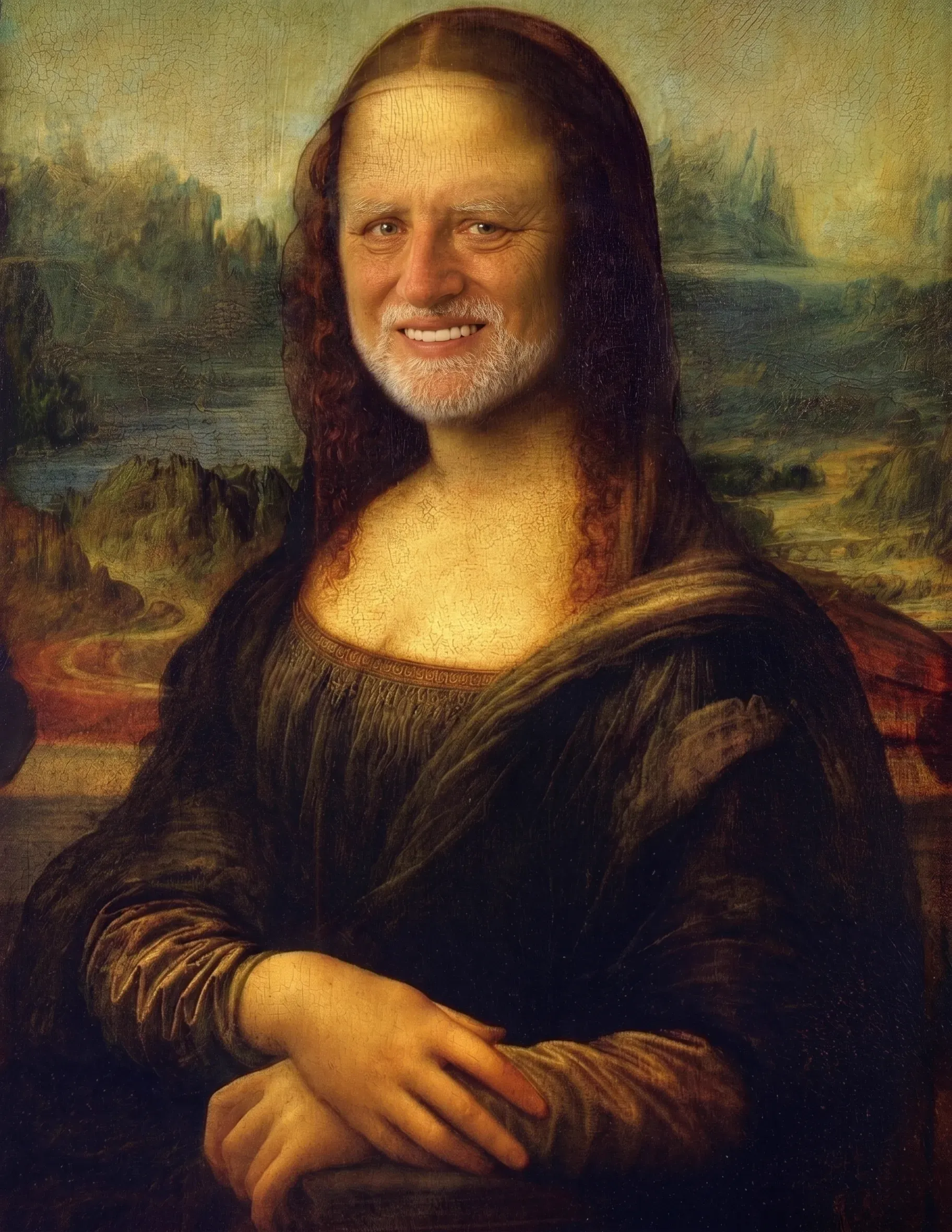
PARIS — Curators at the Musée du Louvre have confirmed that Leonardo da Vinci’s La Gioconda (aka The Mona Lisa) was stolen from the Salle des États over three weeks ago, replaced by a high-resolution giclée print of Hungarian stock-photo icon András Arató, colloquially known to the digital underworld as ‘Hide the Pain Harold’.
The swap went entirely undetected by both museum security and an estimated 640,000 gallery visitors, who continued to jostle four-deep behind velvet ropes, dutifully holding up smartphones to capture the Renaissance masterwork without once glancing at the actual canvas.
The security breach was not uncovered by forensic infrared scans, the Louvre’s bespoke nitrogen-regulated microclimate sensors, or its triple-laminated bulletproof glass casing. Rather, the discovery occurred when Arató’s distant nephew—a conceptual artist visiting Paris to scrape canine faeces off the pavements of Montmartre for an upcoming installation on late-capitalist urban decay—took a casual photograph of the display. Within seconds, Google Photos processed the image, pinged the cloud, and automatically organised the world’s most celebrated Renaissance treasure into an existing album titled Uncle András / Family Barbecue 2019.
Museum administrators immediately launched an internal inquiry, though initial panic has given way to profound institutional paralysis. Exit polling conducted across the museum’s Level 1 wing revealed that visitor satisfaction had surged by 41 per cent during the three weeks Harold occupied the poplar panel.
“The Mona Lisa is the quintessential victim of terminal ‘smartphone gaze’—tens of thousands of tourists shuffling past daily, experiencing the art entirely through a five-inch OLED screen without ever actually looking at the canvas,” noted Julian Finch-Harrow, Senior Fellow of Renaissance Iconography at the Courtauld Institute. “The premise that a stock photo septuagenarian with chronic inner turmoil could hang unchallenged in Leonardo’s frame for three weeks is not only plausible; it’s practically inevitable.”
Finch-Harrow added that the public’s preference for Arató over Lisa Gherardini was entirely rational: “Gherardini’s sixteenth-century smirk is fundamentally alien to the contemporary psyche. Harold’s strained, polite grimace—the desperate, twitching eye contact of a man silently enduring catastrophic psychological distress while clutching a ceramic mug—is the authentic spiritual portrait of modern humanity.”
Louvre director Laurence des Cars, who recently lobbied the French government for a €500-million subterranean bunker in the museum’s basement to sequester the painting away from chaotic crowds, admitted the incident has complicated the relocation timeline.
“For years we have known that visitors leave the Salle des États feeling profoundly disappointed by the painting’s diminutive scale and reflective glazing,” des Cars stated during an emergency briefing. “With Monsieur Arató in the frame, however, people linger. They weep. They feel seen. His eyes follow you around the room! When activists attempted to throw pumpkin soup at the casing last Tuesday, the crowd intervened to protect Harold’s dignity. Usually they are indifferent at such occurrences. ”
Arató himself was flown to Paris on Friday at the expense of the French Ministry of Culture to inspect the installation. Standing before the 77-by-53-centimetre poplar board, the 79-year-old retired electrical engineer observed his own likeness nestled beneath Leonardo’s sfumato veil, adjusted his spectacles, and offered a characteristically sober assessment:
“The lighting is slightly better than the medical equipment catalogue I shot in 2011,” Arató remarked to a swarm of French journalists. “Though standing here for three weeks without an ergonomic office chair would have ruined my lower lumbar. Still, it is nice to be behind bulletproof glass. In Budapest, people simply corner me in the Lidl.”
The French Directorate-General of Police has stated that while an investigation into the whereabouts of the original Da Vinci remains technically open, recovery efforts will proceed with “deliberate administrative slowness.” The Ministry of Culture is currently drafting a proposal to formally ratify the swap, citing reduced insurance premiums, unprecedented gift-shop mug sales, and the undeniable reality that nobody actually missed the original.
Comments ()