
The Hooker in the Toy Box: Why We Crave the Corrupted Childhood
That viral Toy Story image is just the tip of the iceberg. A deep dive into "dual-addressing," the psychology of the adult wink, and the thin line between comedy and predation.
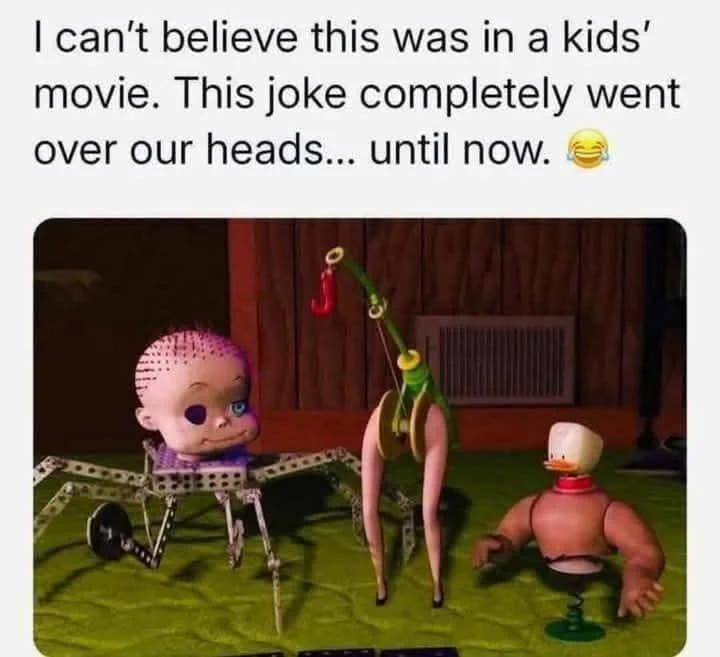
If you’ve been on Reddit lately, you’ve seen it. The screenshot from Toy Story (1995) that ruins your childhood in high definition. Inside the room of the "villain" Sid, we see a pair of Barbie legs attached to a fishing rod.
The visual pun: A Hooker. The reaction: A collective internet guffaw and a thousand "I was today years old" comments.
But the rabbit hole—or rather, the gutter—goes deeper. That hooker isn’t alone. She is flanked by a baby-headed spider with one missing eye (the "One-Eyed Monster," a classic phallic euphemism) and a muscular duck head on a spring (a "Quackhead," phonologically sliding right into "Crackhead").
Pixar's scary neighbour kid was a prop they used to build a Red Light District in his bedroom. And we, the "clever" adults, absolutely love it. But why?
The Dopamine of the "Dual Code"
Linguists call this Dual-Addressing. The media artifact is encoded on two frequencies:
- The Somatic: Bright colours and slapstick for the pre-operational child.
- The Cerebral/Cynical: Taboo references for the parents paying for the tickets.
We don't just like these jokes; we biologically require them. Watching Frozen for the fiftieth time induces a state of cognitive atrophy. When we spot the "Hooker," or catch the moment in Cars when the fan-girls "flash" their headlights at Lightning McQueen, our brains receive a hit of In-Group Dopamine.
It’s a shibboleth. The movie is whispering, "I know you’re bored. I know you know what a hooker is. We are trapped in this G-rated hell together."
The Hall of Fame (and the Hall of Lies)
This practice is the industry standard.
- The Rescuers (1977): Disney actually recalled home video releases because an editor spliced a single frame of a topless woman into a window scene.
- Shrek: The entire franchise is built on the premise that Lord Farquaad is compensating for something (check the name phonetically again: Lord F*wad).
- Animaniacs: The infamous "Finger Prince" joke that somehow aired on daytime TV.
But our desperation for this "adult layer" is so strong that we invent it where it doesn't exist.
Generations of Brits swear they watched Captain Pugwash characters named Master Bates and Seaman Staines. They didn't. The characters were Master Mate and Tom the Cabin Boy (not Roger the Cabin Boy). The creator, John Ryan, successfully sued newspapers for printing the lies. Yet the myth persists because we want the corruption to be real. We prefer a world where the innocence is fake because it validates our own cynicism.
The Dark Turn: When the "Wink" is a Weapon
It stops being funny here. The "adult joke" in a child’s space is a violation of the sanctuary. Usually, it’s a "Benign Violation"—safe fun. But historically, this mechanism has been weaponised by genuine predators to hide in plain sight.
Take Jimmy Savile. For decades, he paraded on Jim'll Fix It and Top of the Pops, using double entendres and "eccentricity" as a shield. His behaviour wasn't hidden; it was framed as a "nudge-nudge, wink-wink" joke. The culture of "adult humour" provided him with plausible deniability. If you pointed out he was creepy, you were the one with the dirty mind. We were all groomed by the screen, laughing at the "cheeky" uncle while he committed atrocities.
We see this same anxiety in how we treat My Neighbor Totoro. The internet is obsessed with the theory that the film is actually a retelling of the horrific Sayama Incident (a real-world child murder case), with Totoro acting as the God of Death. Miyazaki has denied this repeatedly. But we cling to the theory because, in a post-Savile world, we simply do not trust pure innocence. We assume the darkness must be there, lurking just out of frame.
The Verdict on Sid
Which brings us back to Toy Story.
We, the Reddit intellectuals, look at the Hooker and the Quackhead and pat ourselves on the back for getting the joke. "Haha, Pixar put a prostitution joke in a kid's movie."
But look closer at the narrative. Sid is a child living in a house with a hyper-aggressive dog and a father who is passed out in a recliner surrounded by empty cans. Sid isn't a villain; he is a victim of severe neglect.
He constructs "mutant" toys—hookers, drug addicts, monsters—because that is likely the reality he is absorbing from his environment. He is reassembling the debris of a broken home into the only friends he has.
The "Quackhead" isn't a gag for us; it’s a tragedy for him. And the cruelest irony? We’re too busy laughing at the pun to notice the kid screaming for help.


Comments ()